Two Easy Ways I Change the Entire Scene Around a Flower Vase
For a long time, whenever a flower arrangement didn’t feel right in my home, I automatically blamed the vase. I would tell myself it was too short, too plain, too heavy, or simply the wrong shape for the flowers I had chosen. I moved it from table to table, from room to room, sometimes even…
For a long time, whenever a flower arrangement didn’t feel right in my home, I automatically blamed the vase.
I would tell myself it was too short, too plain, too heavy, or simply the wrong shape for the flowers I had chosen.
I moved it from table to table, from room to room, sometimes even replaced it, and still felt that something was missing.
Only recently did I realize that the problem often wasn’t the vase itself, but everything around it.
Flowers don’t exist in isolation. They live in a setting. They interact with height, surface, surrounding objects, and even negative space.
Once I began paying attention to that, I found two very simple adjustments that completely changed how my arrangements looked and felt, especially on days when I was using whatever vases I already had at home.
Tip One: When the Vase Feels Too Short, I Add Height From Below
There are many times when the only available vase in my house is simply too low for the space where I want to place it.
The flowers end up sitting below eye level, visually disappearing into the table or shelf instead of lifting the room. For a long time, I accepted this as a limitation and assumed the only solution was a taller vase.
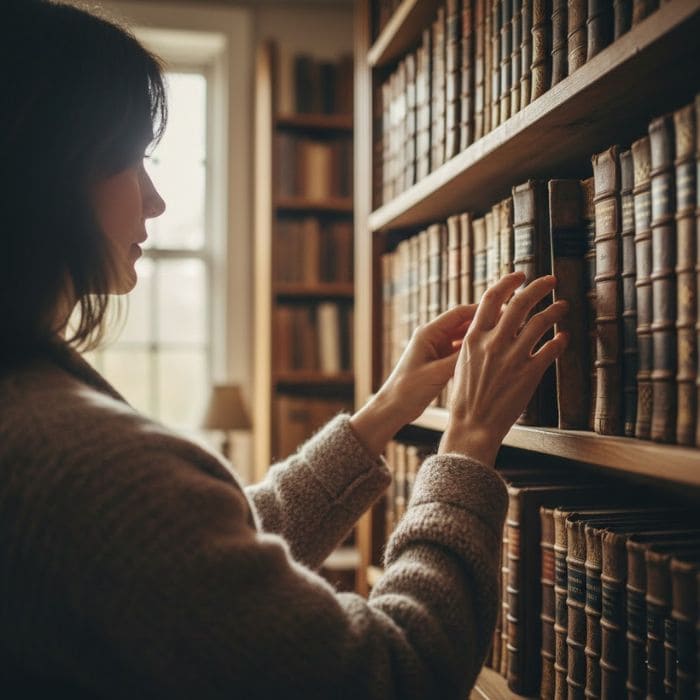
Now, I do something much simpler. I place the vase on a stack of books.
I choose hardcover books that feel sturdy and stable, usually two to four depending on how much height I need. I don’t worry about the titles matching or the spines being decorative.
What matters to me is weight, balance, and surface area. The books need to support the vase confidently, not wobble under it.
This method works especially well on side tables, console tables, and even kitchen counters, where surfaces are often lower than ideal for displaying flowers.
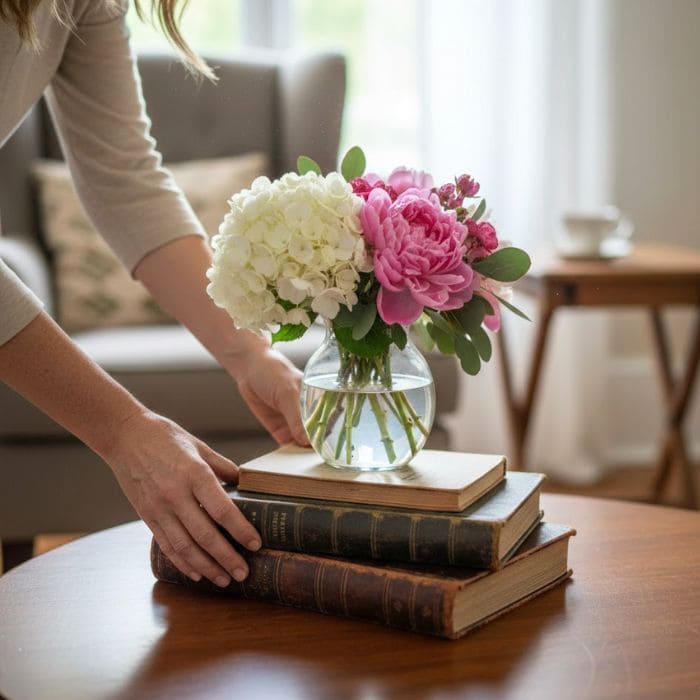
Raising the vase even a few inches can completely change how the arrangement meets the eye, making it feel intentional instead of accidental.
I also pay attention to proportion. If the flowers are full and heavy, I keep the stack lower so the arrangement feels grounded.
If the flowers are light and airy, I allow myself a bit more height. The goal is not drama, but harmony.
What surprised me most is how natural this looks once you get used to it. The books feel like a base, almost like a pedestal, giving the flowers the presence they deserve.
My experience:
On Christmas Day, I like choosing specific Christmas-themed books to stack under a vase instead of random titles.
I often use A Christmas Carol by Charles Dickens, The Night Before Christmas, or an old hardcover copy of The Nutcracker. Books with deep red, forest green, or muted gold spines immediately bring a holiday feeling to the arrangement.
When a winter vase sits on top, the flowers feel naturally connected to the season without adding ornaments or extra decorations, and the whole scene looks thoughtful rather than styled.
Tip Two: Trays Help the Vase Belong to the Space
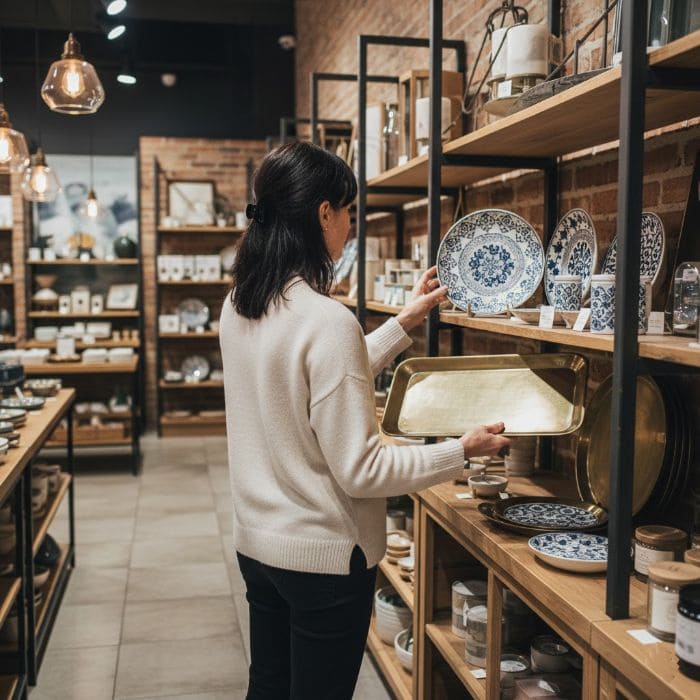
I have to admit something honestly. I only started using trays intentionally for styling about a month ago, and now I don’t understand why it took me so long.
Before that, trays were purely functional in my home, used for serving or organizing small items, never as part of decoration.
A tray creates a boundary. It tells the eye that what’s inside belongs together. When I place a vase directly on a large surface, such as a dining table or coffee table, it can feel lonely, almost unfinished. When I place that same vase on a tray, suddenly it feels grounded, framed, and purposeful.
I experiment with different types of trays depending on the mood of the room.
Wooden trays feel warm and calm. Metal trays feel structured and clean. Ceramic trays feel soft and intentional. I don’t overthink it. I choose what feels right that day.
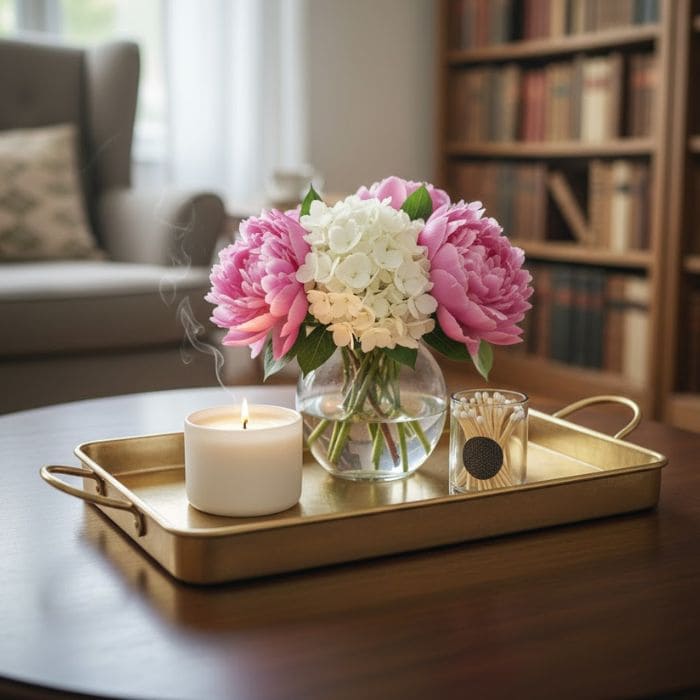
On the tray, I usually place one or two additional items beside the vase. A small scented candle, a match holder, sometimes a small object with personal meaning.
I avoid clutter, because flowers should still lead the scene. Everything else is there only to support them quietly.
Scale matters here more than people realize. A small vase on a very large tray feels lost, while a large vase on a tiny tray feels cramped.
When the proportions are balanced, the arrangement feels calm and finished without trying too hard.
When I Use Both Methods Together
There are days when I combine both techniques, especially when I’m working with a short vase in a large space. I place the vase on a small stack of books and then set the entire stack onto a tray.
When done thoughtfully, this layering doesn’t feel excessive. Instead, it creates depth and structure.