The New Way to Try When I Truly Want Flowers to Last
Before I write anything else, I want to say this clearly. I still believe in simple, home-based flower care. In previous posts, I shared my own ways of using coins, sugar, and careful water changes to keep flowers fresh longer, and those methods genuinely helped me in many situations. They are useful, accessible, and often…
Before I write anything else, I want to say this clearly.
I still believe in simple, home-based flower care. In previous posts, I shared my own ways of using coins, sugar, and careful water changes to keep flowers fresh longer, and those methods genuinely helped me in many situations.
They are useful, accessible, and often enough for everyday arrangements.
But over time, I learned something important. Not every flower responds well to those methods, and some flowers react badly, even when I do everything carefully.
When My Usual Tricks Started Failing Me
There was a period when I felt frustrated, even slightly embarrassed, because arrangements that should have lasted simply didn’t.
Roses clouded the water too quickly. Garden roses opened beautifully and then collapsed overnight. Tulips bent dramatically no matter how often I changed the water. Hydrangeas looked hydrated one day and tired the next.
I tried my usual methods. I added clean coins to slow bacterial growth. I mixed a small amount of sugar and dish soap, just as I had shared before.
Also, I changed the water regularly and re-cut stems carefully. Sometimes it helped, but other times, it made no difference at all.
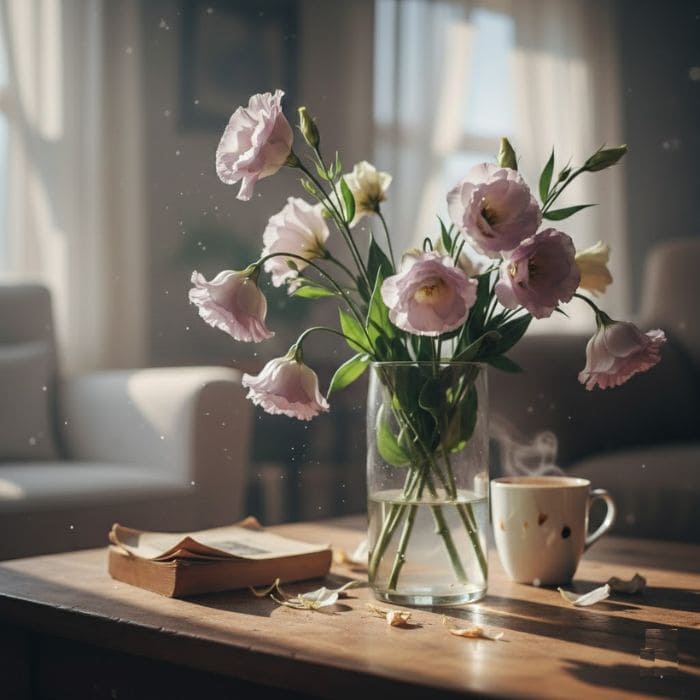
Certain flowers simply didn’t tolerate these solutions well. Delicate blooms like eustoma became soft too quickly. Garden roses seemed to rot at the stem. Hydrangeas reacted unpredictably, sometimes wilting faster instead of improving.
I realized that while home remedies can work, they are not neutral solutions. They interact differently with different flowers.
That was when I decided to ask Jennifer directly.
The Conversation That Changed My Approach
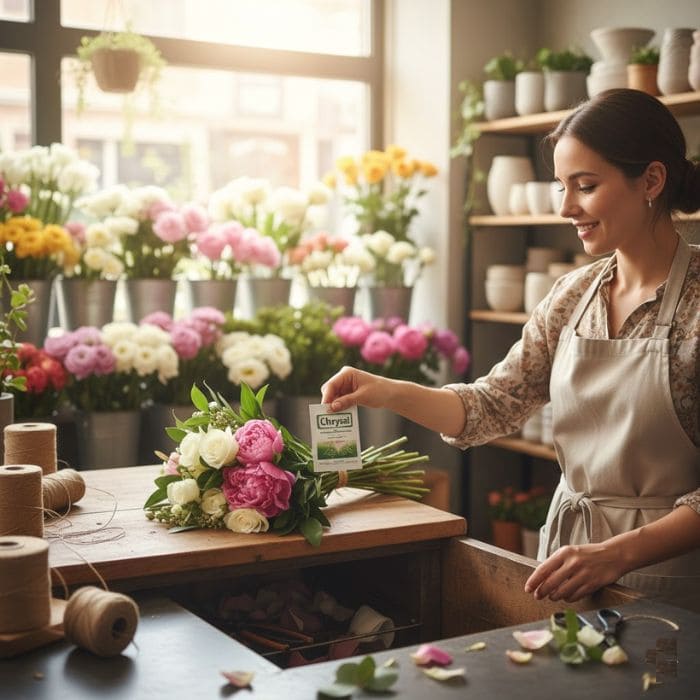
At Jennifer, I stood at the counter longer than usual, clearly hesitating. Jennifer noticed and asked what was wrong.
I told her honestly that I was doing everything I knew how to do, yet some flowers refused to last, no matter how careful I was.
Then she asked a simple question. “What are you putting in the water?”
When I explained my methods, the coins, the sugar, the soap, she nodded slowly and said something that stuck with me.
“Those tricks can help,” she said, “but they’re not designed for every flower as some blooms are sensitive.”
Then she reached under the counter and placed a small packet in front of me.
“This is what we use when we don’t want surprises.”
This was the official time Chrysal entered my routine.
Why Some Flowers Don’t Like Home Remedies
Jennifer explained something I hadn’t fully considered. Home remedies usually focus on one problem at a time.
Sugar feeds flowers but also feeds bacteria. Coins slow bacteria but don’t provide energy. And soap reduces surface tension but can stress delicate stems if the ratio isn’t exact.
Flowers like garden roses, hydrangeas, tulips, stock, and eustoma are particularly sensitive to imbalance.
Their stems clog easily. Their water uptake depends heavily on pH and cleanliness. When that balance is off, even slightly, they decline quickly.
Therefore, my methods worked beautifully for some arrangements and failed completely for others.
How I Use Chrysal, Very Specifically
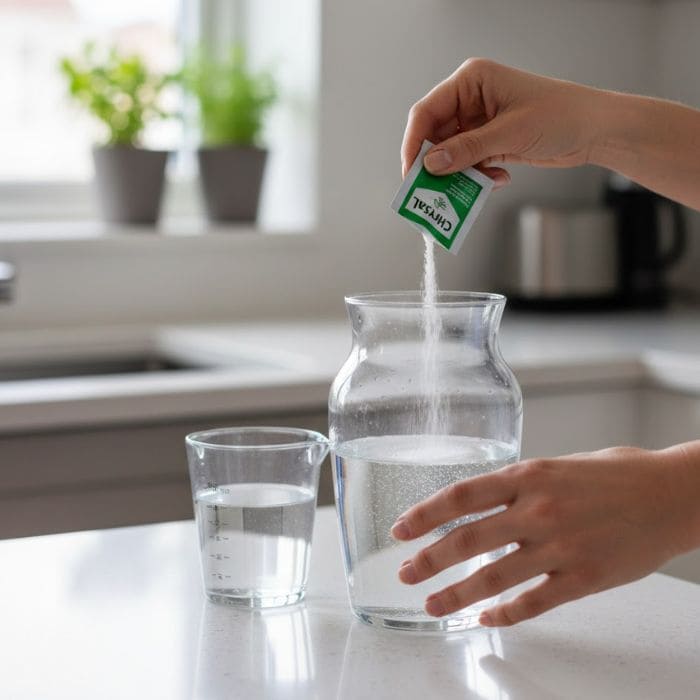
When I decide to use it, I start with a completely clean vase. I fill it with fresh, room-temperature water.
For a standard home vase, I use approximately one liter of water, which is just over four cups.
Into that water, I dissolve one full packet of Chrysal, stirring gently until it is fully dissolved and no residue remains at the bottom.
I never guess the amount. One packet per liter is important as too concentrated stresses the flowers, too diluted weakens the effect.
Only after the solution is ready do I re-cut the stems at a sharp angle, remove all leaves below the waterline, and place the flowers inside.
Of course, I don’t add anything else – no sugar, no coins, and no soap. When I use flower food, I let it work alone.
What Changed After I Started Doing This
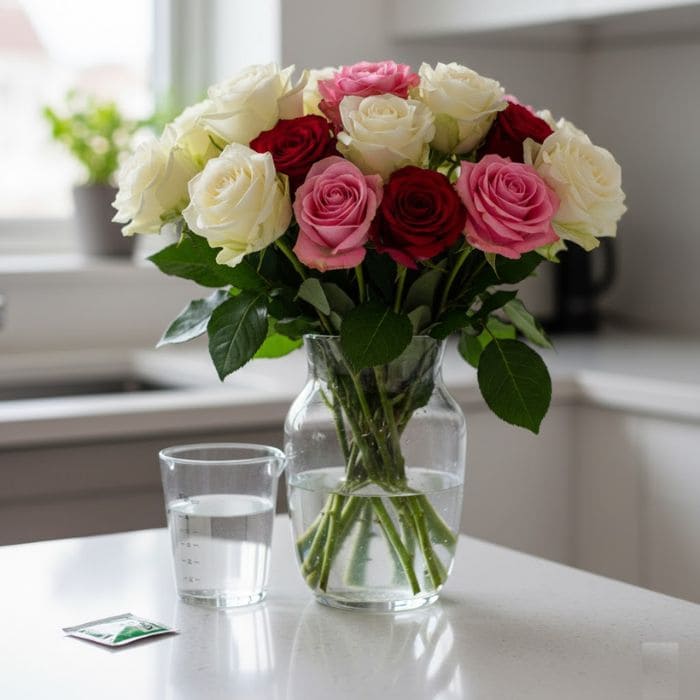
I saw the water stayed clear longer, especially with roses and hydrangeas, which used to cloud quickly for me.
The sour smell I used to notice after a few days simply didn’t appear. Stems stayed firm instead of turning soft and brown at the base.
Most noticeably, buds behaved differently. Tulips bent less aggressively. Garden roses opened wider and held their shape instead of collapsing suddenly.
Eustoma, which had always felt fragile to me, stayed upright and fresh longer than I was used to.
In many cases, arrangements lasted more than seven days in good condition, not frozen in time, but aging slowly and predictably.
About Safety and Why I’m Comfortable Using It
I don’t treat this casually. I keep packets stored away, wash my hands after handling, and never reuse the water for anything else.
Used as directed, it is considered safe for household use, and I’m careful not to overuse it.
One detail that mattered to me is that the packets themselves are made from TCF pulp with a water-based coating, meaning they can be placed in the recycling bin.
That doesn’t make it perfect, but it aligns better with my values than constant trial-and-error waste.
How This Fits Into My Routine Now
I still use my home methods sometimes, especially for sturdy flowers or casual arrangements that don’t need to last.
But when I bring home flowers that are sensitive, meaningful, or meant to stay with us through a week of daily life, I reach for this method instead.
I’m sharing this not to replace what I’ve already taught, but to add context. Flower care isn’t one-size-fits-all.
If you’ve ever felt confused because your usual tricks suddenly stopped working, you’re not doing anything wrong. Sometimes the flowers are simply asking for a different kind of support.