A Week of Full Poppies in My House
Ever since we came back from California, my mind has been full of poppies. When I close my eyes, I still see those orange hills moving under the wind. Even while folding laundry or washing dishes, I thought about that particular shade of orange that only poppies seem to carry. A few nights ago, while…
Ever since we came back from California, my mind has been full of poppies.
When I close my eyes, I still see those orange hills moving under the wind. Even while folding laundry or washing dishes, I thought about that particular shade of orange that only poppies seem to carry.
A few nights ago, while I was telling my husband that I couldn’t stop thinking about them, he laughed and said, “I see poppies are beautiful, but their scent is earthy, a little smoky, actually.”
I told him he was wrong. To me, poppies feel citrusy, lightly sweet, almost like sun-warmed zest in the air. He insists they lean more toward dry soil and faint smoke.
We stood in the kitchen debating the fragrance of a flower neither of us had actually smelled in a field that large, and we ended up laughing at ourselves.
Still, that conversation made me decide something. If I couldn’t go back to Antelope Valley immediately, I would bring poppies into my home.
Understanding Poppies Before Arranging Them
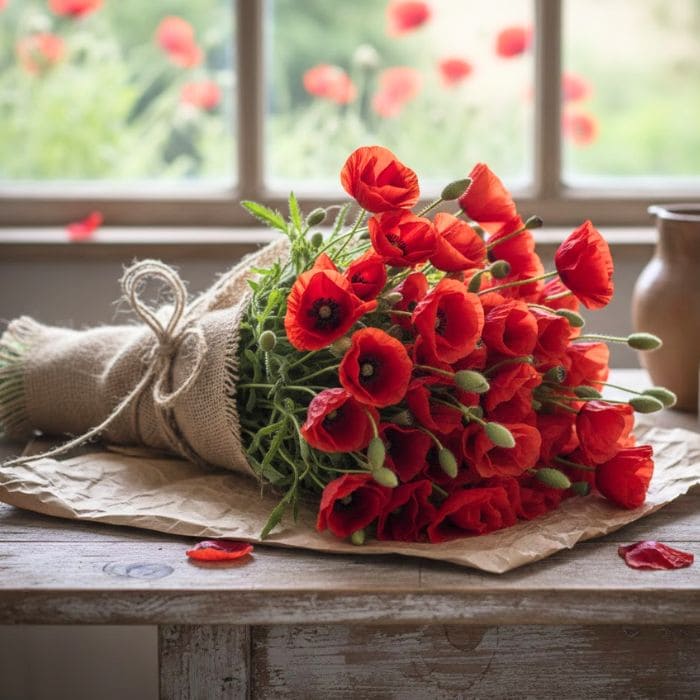
Poppies are very different from roses, tulips, or chrysanthemums. They are softer, more fragile, and less obedient. Also, the stems are thinner and often slightly fuzzy.
The blooms are papery and delicate, with petals that wrinkle gently like silk fabric.
Unlike structured flowers such as carnations or garden roses, poppies do not hold a tight shape. They move, lean, and respond to light.
In fact, many poppies close their petals slightly when light fades, which means your arrangement can look subtly different throughout the day.
This characteristic makes them beautiful, but also challenging.
Choosing the Poppies
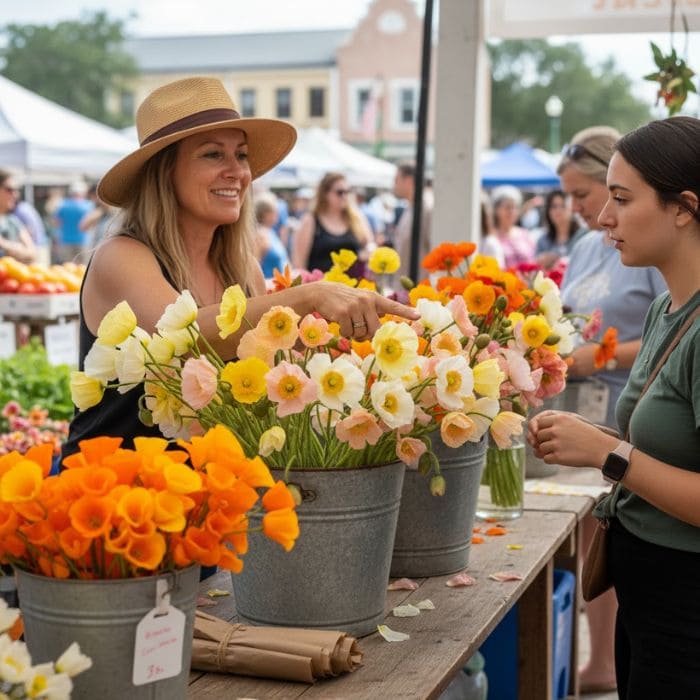
Inspired by the hills of Antelope Valley, my first instinct was to buy only bright orange poppies.
However, when I visited Mount Dora Village Market last Saturday morning, I was surprised to see a vendor displaying several varieties, not only classic orange California poppies but also Iceland poppies in pale yellow, soft peach, blush pink, and even creamy white.
The seller, a woman named Teresa who often brings seasonal blooms from a local grower in central Florida, noticed me studying the colors carefully.
She smiled and said, “If you loved the orange fields, take some of those. But the mixed Iceland poppies last longer in a vase.”
We talked for several minutes about stem strength and bloom behavior.
She explained that Iceland poppies, though still delicate, tend to have slightly sturdier stems and a broader color range, making them more versatile for indoor arrangements.
I left with two bunches of orange poppies and one mixed bundle of yellow and pale peach.
The Arrangement Process
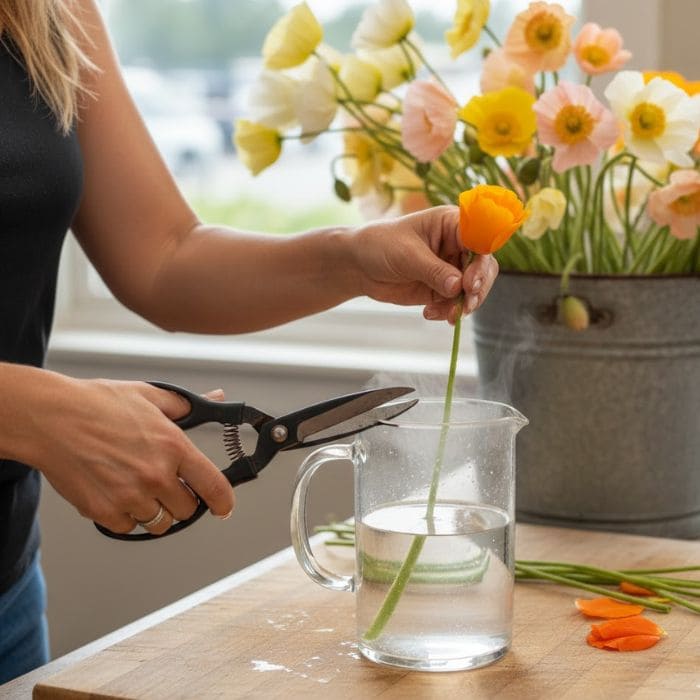
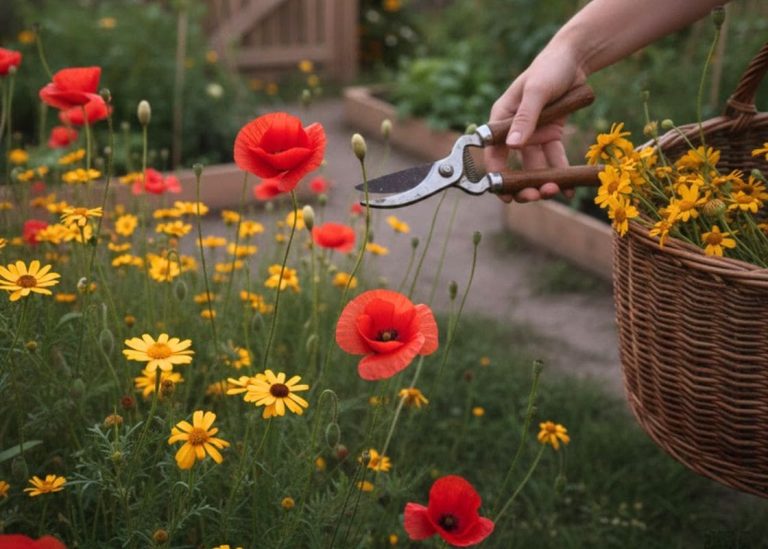
Back home, I started by trimming every stem at a 45-degree angle using sharp floral shears. Immediately after cutting, I dipped the bottom inch of each stem into hot water for about ten seconds.
This step seals the sap and helps reduce early wilting. I then transferred the stems directly into lukewarm water inside the vase.
For the vase, I chose a clear glass cylinder about 9 inches tall with a slightly narrowed opening. Poppies need gentle support from one another. A wide bowl would have allowed them to collapse outward too easily.
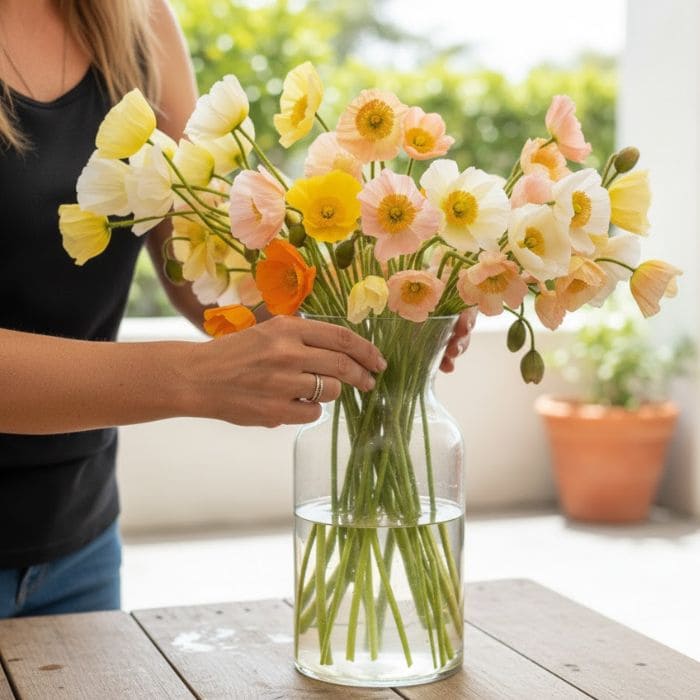
I sorted the stems by height and bloom size before placing them in the vase.
The tallest orange stems formed the center, but instead of clustering them tightly, I spaced them about half an inch apart to allow light and air between petals.
Around them, I added the peach and yellow poppies in a circular motion, rotating the vase slightly after placing each stem.
I adjusted constantly. If one bloom leaned too dramatically, I removed it and repositioned it rather than forcing it into place. Poppies bruise easily, so handling them gently is essential.
I intentionally left negative space between blooms. That airiness allowed each flower to be visible rather than buried in color.
By late afternoon, as sunlight filtered through the window, the petals had opened further, and the arrangement looked almost twice as full as it had in the morning.
After that, the movement was subtle but constant. Some stems curved slightly toward the window, while others stood upright for hours before gradually bending.
Living With Poppies for a Week
Living with poppies is very different from living with roses.
On the first day, they looked alert and freshly placed, petals smooth and slightly cupped. By the second day, the blooms had fully opened, revealing their golden centers and delicate textures.
The orange deepened in tone under afternoon light, while the peach shades looked softer and almost luminous in the morning.
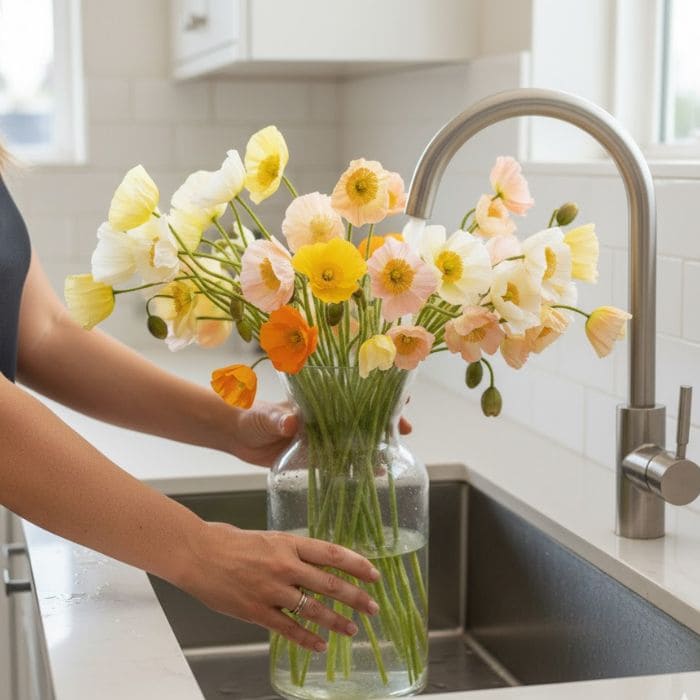
By the third day, I noticed that water levels dropped faster than with other flowers. Poppies drink generously, especially in a warm kitchen.
I changed the water every two days and re-trimmed the stems by about half an inch to keep them hydrated.
On the fourth day, a few petals began to fall gently onto the table. Instead of feeling disappointed, I found it beautiful. The fallen petals looked like silk scattered across the wood.
Some blooms lasted five days, others faded sooner. The buds that were closed on Saturday opened beautifully by Monday, extending the arrangement’s life naturally.
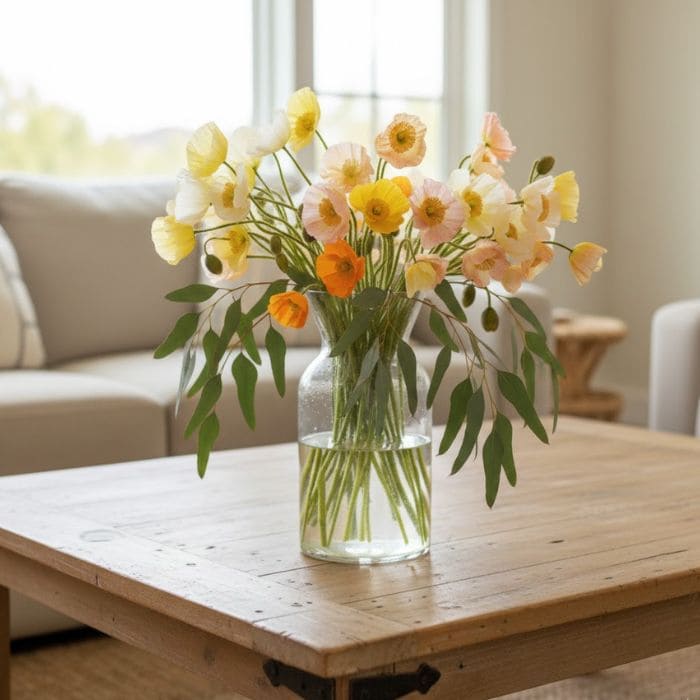
I also experimented midweek by adding two thin eucalyptus stems to provide subtle structure.
The cool green contrasted sharply with the warm orange and yellow tones, stabilizing the composition without overpowering the poppies’ airy character.
Throughout the week, I noticed how strongly poppies respond to light.
In the evening, when the sun lowered and shadows lengthened, some blooms gently closed partway. In the morning, they reopened as if greeting the day.
By the end of the week, most of the blooms had completed their cycle.
The petals softened and eventually dropped, leaving curved stems and textured seed pods behind. Even those pods were beautiful in their own way.
Arranging poppies for a week taught me patience in a different form. You cannot expect them to hold perfect shape for ten days.
And in return, they give you movement, lightness, and a reminder that not every flower is meant to stand still.
Read more: Our Trip to Antelope Valley California Poppy Reserve