Our Trip to Antelope Valley California Poppy Reserve
About a month ago, on a Tuesday evening after dinner, I was standing at the kitchen sink rinsing plates when I told my husband that I felt restless. I said I wanted to go somewhere wide, somewhere with open sky and real wind. Then he dried his hands, leaned against the counter, and said, “Then…

About a month ago, on a Tuesday evening after dinner, I was standing at the kitchen sink rinsing plates when I told my husband that I felt restless.
I said I wanted to go somewhere wide, somewhere with open sky and real wind. Then he dried his hands, leaned against the counter, and said, “Then we wait for spring.”
He didn’t explain, and that was the entire conversation.
Three weeks later, he placed two printed flight tickets on the dining table. The tickets were from Orlando to Los Angeles and the departure early morning.
I asked him what was in Los Angeles for us. He just smiled and said, “Not Los Angeles.”
When we landed in California, we rented a car and drove north, past downtown traffic, past industrial buildings, and eventually onto long stretches of open highway.
The landscape changed slowly, the air looked drier, and the sky looked wider.
After about ninety minutes, he pulled into the entrance of the Antelope Valley California Poppy Reserve near Lancaster.
The First View of the Hills
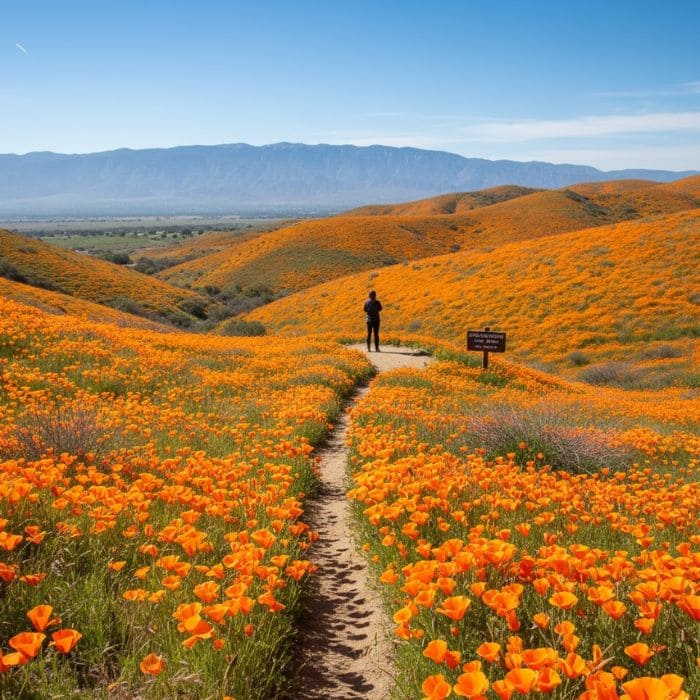
The reserve sits at about 3,000 feet elevation, and the wind meets you immediately, as if it belongs there more than you do.
When we reached the first overlook point, I stopped walking. Then I saw the hills were orange.
Entire slopes brushed in bright California poppies, moving in waves under the wind. The flowers were open wide in the midday sun, their petals thin and luminous, almost glowing against the pale green grass beneath them.
The California poppy, Eschscholzia californica, is not a tall flower. Most of them reach about 12 to 18 inches high.
The blooms themselves are about two to three inches across, shaped like small cups with four silky petals and a golden center.
When the sun is strong, they open fully. When clouds pass or evening comes, they fold inward again.
Seeing thousands of them at once changed how I understood scale. In my garden, a handful of blooms fill a vase. Here, entire hills were covered.
Walking the Trails Slowly
We chose one of the main loop trails, about three miles total, and walked without rushing.
The park has several designated trails that wind gently through the hills, and it is important to stay on them. The soil is fragile, and stepping off-path damages the growth pattern for future seasons.
The wind kept moving through the flowers like a hand brushing over fabric. Every few minutes, the hills would shift in tone as the poppies leaned in the same direction.
There were patches of purple lupine mixed in, tall and spiked, and occasional clusters of small yellow wildflowers adding another layer of color.
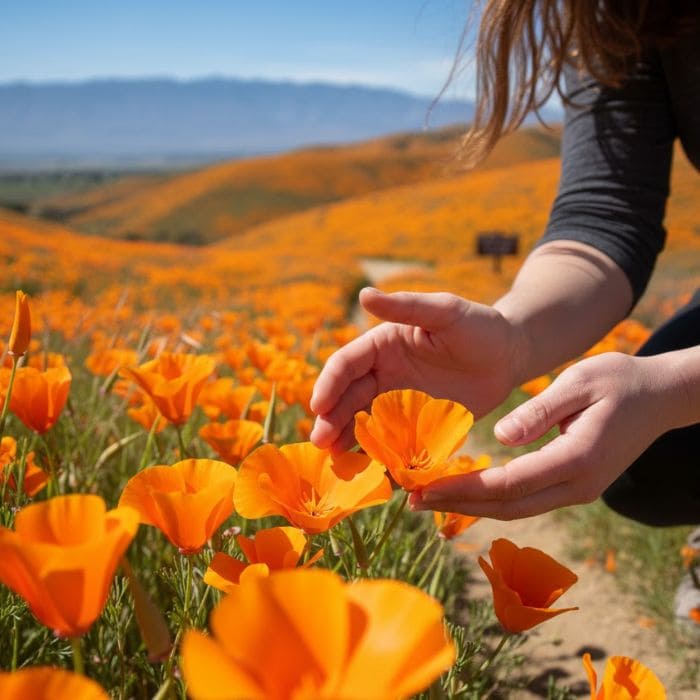
At one point, I crouched down near the edge of the trail to examine a single bloom.
Up close, the petals looked almost translucent, thin enough that sunlight passed through them. The center held tight clusters of golden stamens, bright and intricate.
My husband stood quietly beside me and said, “You were right. This is wide.”
The Reason He Chose This Place
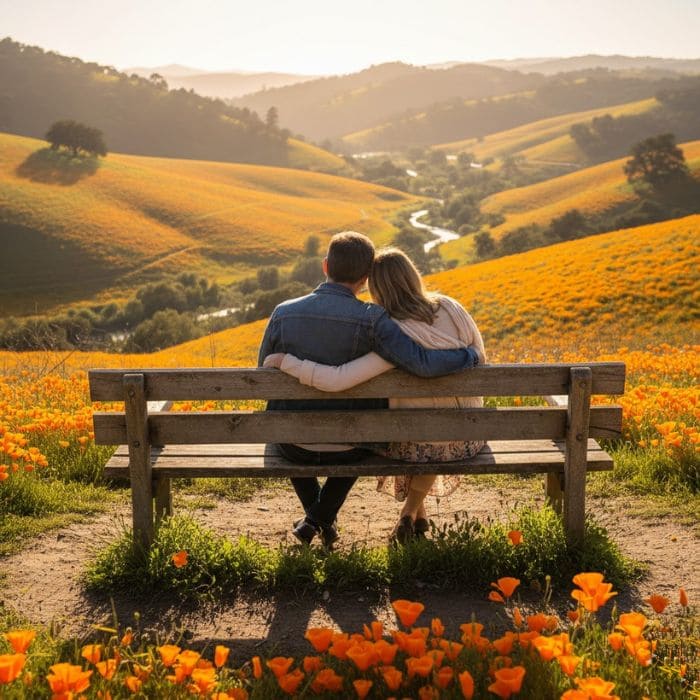
Later that afternoon, while we were sitting on a wooden bench overlooking the valley, he told me why he picked this reserve.
He remembered that years ago I once mentioned wanting to see a field that felt endless, not a garden, not a park with arranged beds, but something wild and seasonal.
He had researched bloom forecasts and rainfall reports months in advance. The intensity of the bloom depends on winter rain, and this year had enough to create a strong display.
Also, he watched updates from the reserve and chose a weekend when the bloom was reported as near peak.
Practical Tips If You Visit
If you ever want to visit the Antelope Valley California Poppy Reserve, timing is everything.
The bloom depends heavily on winter rainfall, and some years are more dramatic than others. The best months are typically March and April, but it’s wise to check official bloom updates before booking.
Go in the morning if possible, as the light is softer, the wind is usually gentler, and the poppies are open once the sun warms them. Midday can be brighter for photography, but the wind often increases.
Next, wear comfortable shoes because the trails are natural and slightly uneven, and bring water. Even in spring, the sun can be stronger than expected.
Most importantly, stay on marked trails. It may be tempting to step closer into the fields, but the ecosystem is delicate.
What I Felt Standing There
Standing in the middle of those hills, I felt the kind of quiet that comes when you realize something exists without needing you to arrange it.
At home, I trim stems, adjust angles, remove leaves, and choose vases. Here, nothing was trimmed. The poppies grew where wind and rain allowed them to grow.
When we drove back toward Los Angeles that evening, I kept looking at the hills through the car window until they disappeared behind us.