Here’s My Personal Flower Combination Guide
After I shared the wild-flower vase from my backyard, I noticed something interesting happening in the comments. Many of you weren’t asking where the flowers came from or how long they lasted. Instead, you were asking something much more basic and much more important. “How do you know which flowers actually belong together in one…
After I shared the wild-flower vase from my backyard, I noticed something interesting happening in the comments.
Many of you weren’t asking where the flowers came from or how long they lasted. Instead, you were asking something much more basic and much more important.
“How do you know which flowers actually belong together in one vase?”
I realized then that I should have written this much earlier. Flower combination is often the most intimidating part for beginners, yet it’s rarely explained in a practical, home-based way.
What I’m sharing here comes entirely from experience. These are combinations I’ve used repeatedly in my own home, through hot days, busy weeks, delayed water changes, and arrangements that had to survive real life.
1. Stock + Eucalyptus + White Eustoma
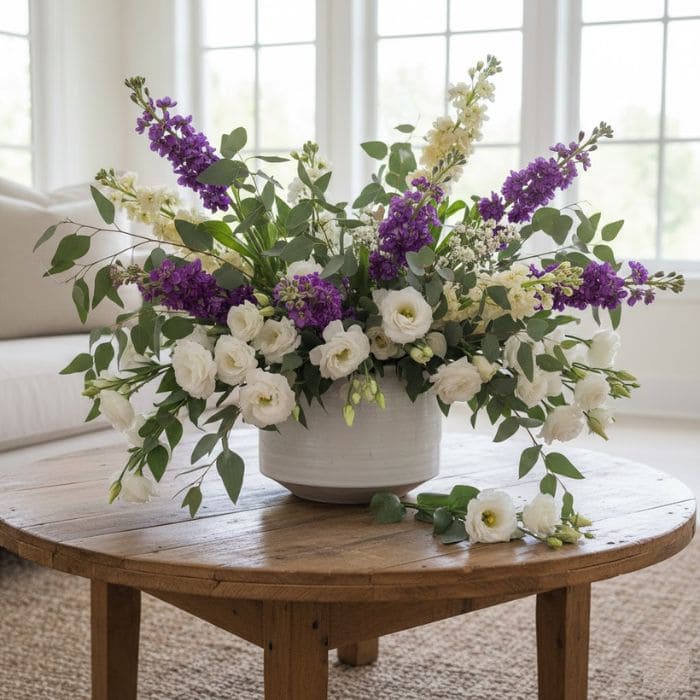
This is the combination I reach for when I want something that feels grown-up and calm.
Stock provides the vertical structure. Its stems are firm, and its blooms open gradually from the bottom upward, which means the arrangement evolves slowly instead of peaking all at once.
Stock also has a natural fullness that allows you to use fewer stems while still achieving presence. The soft, clove-like fragrance adds depth to the room without overwhelming it.
Eucalyptus acts as the stabilizer. Visually, its muted green tones cool the palette and prevent the arrangement from feeling too floral or heavy.
Structurally, eucalyptus creates spacing between flowers, allowing air to circulate and stems to rest naturally against one another.
It also lasts exceptionally well in water, which makes it an ideal companion for more delicate blooms.
White eustoma is what softens everything. Its petals are thin, layered, and slightly translucent, catching light in a way that feels gentle rather than showy.
Unlike roses, eustoma doesn’t dominate. It blends. It fills gaps. It gives the arrangement a relaxed rhythm.
I always cut stock slightly taller than eucalyptus, then let eucalyptus form a middle layer before adding eustoma last. I never try to position the eustoma precisely. It looks best when it falls naturally.
This arrangement works beautifully in medium-height vases with a narrow opening, and it improves visually after the first day rather than declining.
2. Monochromatic Tulips
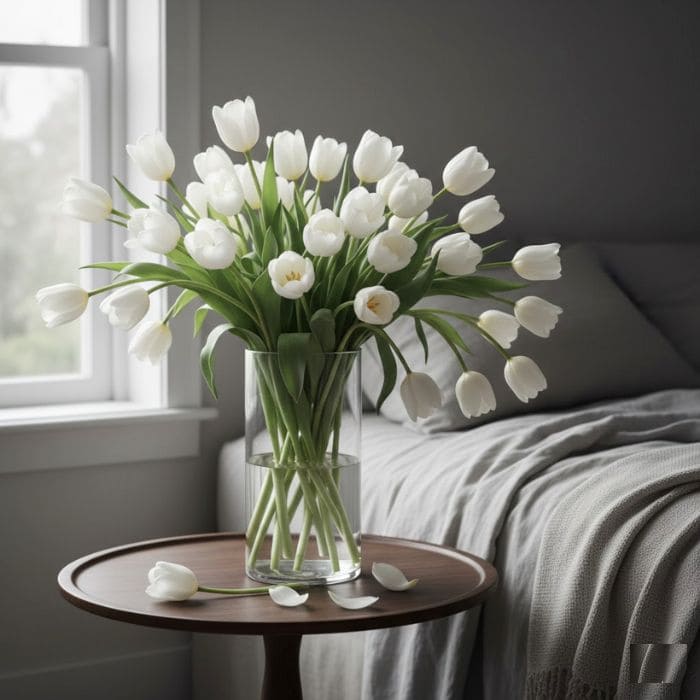
When I want an arrangement that feels emotionally quiet and visually clean, I choose tulips in one single color.
Tulips are alive in a way few flowers are. Their stems continue to grow after being cut. They bend toward light. They shift position throughout the day.
When multiple colors are combined, that movement can feel chaotic. When they are kept monochromatic, the movement becomes graceful.
A single color allows your eye to focus on shape, rhythm, and change. You begin to notice how some buds open sooner than others, how the stems arc at different angles, how the petals soften gradually over time.
My personal tips:
I use tall, straight-sided vases and cut the stems at varying lengths. I never force tulips upright. I let them lean.
This arrangement often looks its best around day two or three, when the flowers have settled into themselves.
3. Red Roses + Baby’s Breath
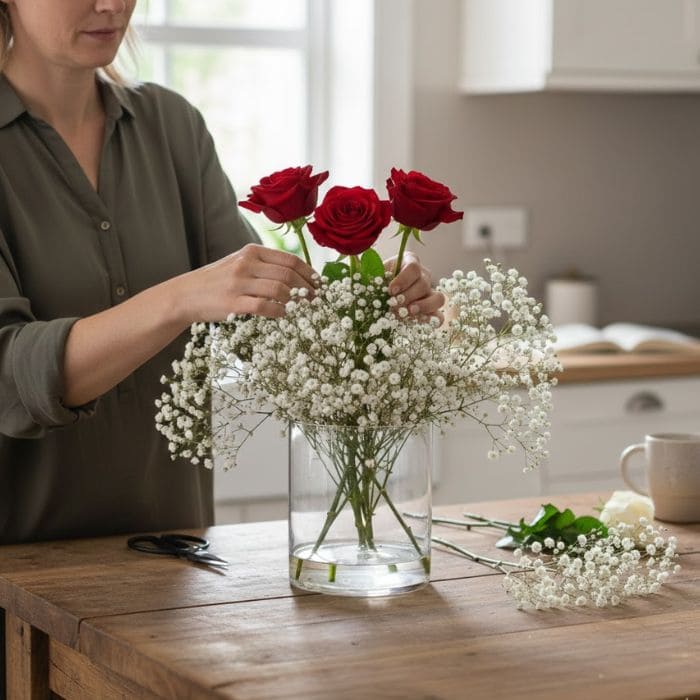
This combination is often dismissed as too classic or too familiar, but that is exactly why I trust it.
Red roses bring weight and intention. Their stems are thick, their heads are dense, and their presence is immediately felt.
When roses are placed alone in a vase, especially in large numbers, they can feel heavy both visually and physically. Blooms press against each other, moisture gets trapped, and petals bruise faster than expected.
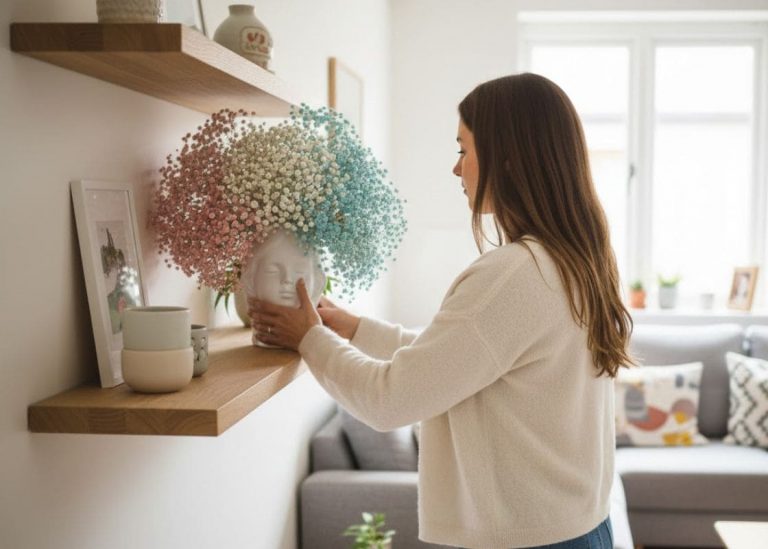
Baby’s breath introduces air into the arrangement. Its branching stems create natural spacing between rose heads, which improves air circulation and reduces moisture buildup.
Roses surrounded by baby’s breath tend to open more evenly and hold their shape longer because they are not constantly rubbing against neighboring blooms.
Visually, the baby’s breath softens the intensity of red roses. Red can be emotionally strong, even dramatic, but the fine white blooms calm that energy without dulling it.
My notes:
I never overcrowd roses in this combination. For a medium vase, three to five roses are enough.
I build the base with baby’s breath first, allowing it to fan outward naturally, then insert roses as anchors rather than focal points.
I also trim rose stems slightly shorter than usual so the blooms sit comfortably within the cloud of white rather than towering above it.
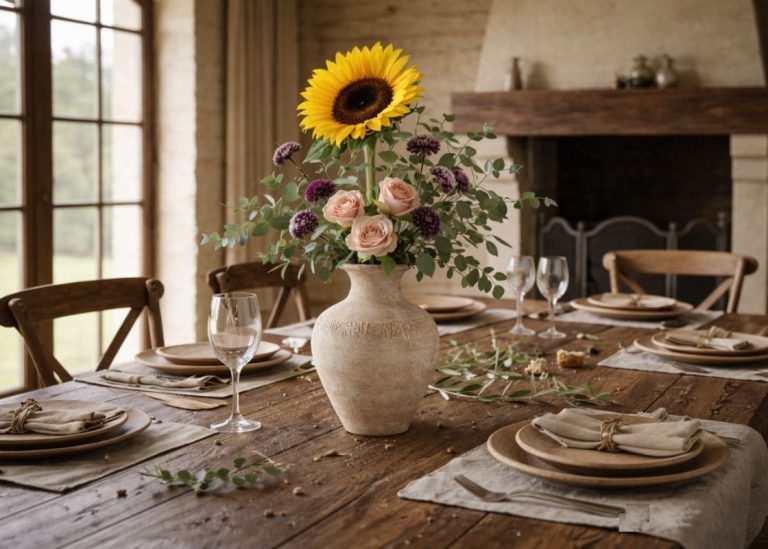
4. Sunflowers + Purple Hydrangeas
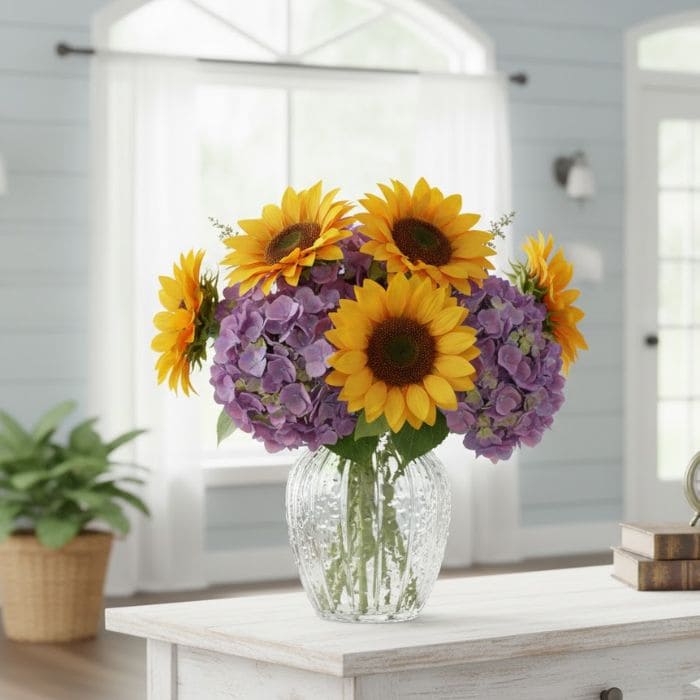
This is the combination I reach for when the house feels quiet but the season outside is loud.
Summer light can be harsh, especially in Florida, and not every flower handles that intensity well indoors. Sunflowers thrive in it, but on their own, they can feel almost too bold for a living space.
Sunflowers are unapologetic. Their faces are large, their centers defined, their stems thick and upright. They bring confidence into a room immediately. Purple hydrangeas, on the other hand, bring volume and calm.
Their clustered petals absorb light rather than reflect it, which visually softens the sunflower’s brightness.
The contrast between the sunflower’s structured center and the hydrangea’s rounded mass creates a balanced tension. One flower leads with clarity, the other supports with abundance.
The purple tone specifically is important here. Purple cools yellow without flattening it, preventing the arrangement from feeling childish or overly cheerful.
Structurally, hydrangeas also help stabilize sunflowers. Their large heads rest against each other, creating a supportive base that prevents sunflower stems from leaning too aggressively in one direction.
Notes:
Hydrangeas must be fully hydrated before arranging. I always submerge their heads briefly in cool water and re-cut stems before placing them in the vase.
I position hydrangeas slightly lower than sunflowers so they form a visual foundation.
5. Red Tulips + White Carnations
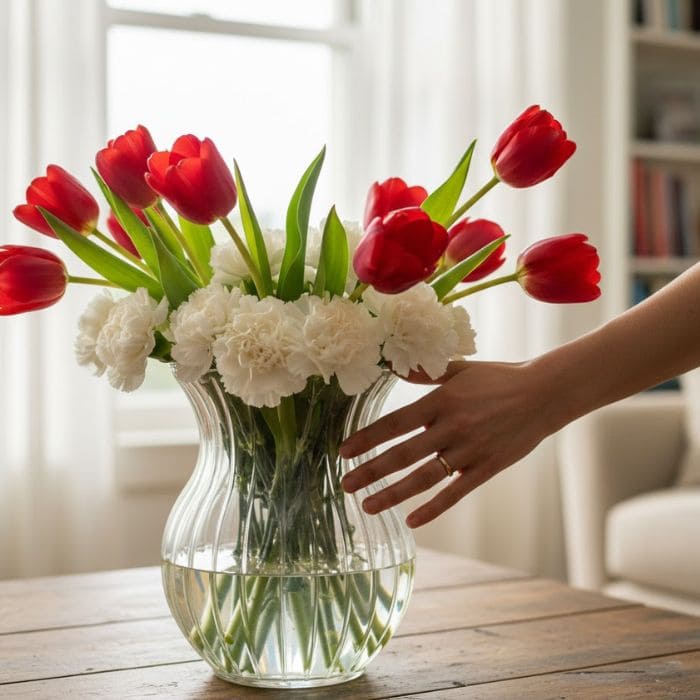
This is my favorite vase, not because it is dramatic. Red tulips bring sincerity and upright strength. White carnations bring patience, volume, and time.
Tulips are expressive flowers. They move, stretch, and respond to light constantly. Their stems are flexible, which makes them feel alive, but also means they can droop quickly if unsupported. Carnations quietly solve this problem.
White carnations are one of the most underestimated flowers in home arrangements.
Their stems are sturdy, their blooms are layered and resilient, and they tolerate temperature changes better than many premium flowers. They also last significantly longer than tulips, which makes them ideal partners.
I always arrange carnations first, building a supportive base at the bottom of the vase. Then I add tulips loosely, allowing them to lean naturally against the carnations rather than fighting gravity.
I cut tulip stems slightly longer than the carnations so their movement remains visible. This vase doesn’t peak quickly. It settles, and then it holds.